
Kabaddi
From Mud to the League: Kabaddi's Changing Face
कबड्डी एक संपर्क टीम खेल है जिसमें सात खिलाड़ी मैदान पर होते हैं। रेडर को तीस सेकंड के भीतर, लगातार साँस खींचते हुए (कबड्डी-कबड्डी का उच्चारण करते हुए) विपक्षी आधे हिस्से में एक डिफ़ेंडर को छूकर अपनी रेखा पार करनी होती है। सफल रेड पर एक अंक, सफल टैकल पर एक अंक, और विपक्षी टीम के सभी खिलाड़ियों के आउट होने पर दो अंक का लोना मिलता है। तीसरे निरंतर खाली रेड पर अंक न लेने वाला रेडर स्वयं आउट हो जाता है, जिसे डू-ऑर-डाई रेड कहा जाता है। पेशेवर फ्रेंचाइज़ी लीग 2014 में शुरू हुई और उसने प्रसारण, खिलाड़ी आय और सार्वजनिक पहचान तीनों को बदला। अंतरराष्ट्रीय स्तर पर कबड्डी एशियाई खेलों का हिस्सा रही है, जिसमें भारत परंपरागत रूप से सबसे मज़बूत टीम रहा है, जबकि ईरान ने हाल के वर्षों में गंभीर चुनौती पेश की है। महिला कबड्डी भी एशियाई खेलों में शामिल है, पर दृश्यता और वित्त पोषण में अभी भी असमानता बनी हुई है। नोट: यह सामग्री कबड्डी खेल की सामान्य पृष्ठभूमि, नियमों और विकास पर आधारित है; इसमें किसी विशिष्ट मैच का स्कोर, तारीख़ या खिलाड़ी-स्तरीय आँकड़ा शामिल नहीं है क्योंकि उपलब्ध इनपुट में ऐसा कोई सत्यापित विवरण नहीं था।
Kabaddi is one of those sports you do not need to learn from a rulebook. Two minutes at the edge of the mat are enough. Seven players, one line, and a thirty-second count that makes everyone hold their breath. A sport once played barefoot on village soil now stands between television graphics, franchise kits and multi-crore auctions. But the change is not only about clothing and cameras. It is a change in the mathematics inside the game, in its training systems and in its economy.
The core rule of kabaddi is extremely simple, and that is its greatest strength. A raider crosses into the opponent's half, must touch a defender and return across his own line within thirty seconds, and throughout must chant kabaddi-kabaddi in a single continuous breath. Break the breath and the raid ends. That single condition makes kabaddi one of the most unusual sports in the world, because endurance here is not merely a training goal but a rule of the game.
The scoring structure looks small but its impact is large. One point for a successful raid, one for a successful tackle. And when every player of the opposing team is out, the side earns a lona, two extra points, after which the entire team returns to the mat. The lona is the single biggest strategic event in kabaddi, because in one moment both the points gap and the balance of players on the mat change.
Raiding in modern kabaddi is no longer blind aggression. A raider first spends three to five seconds reading the defence: which defender has shifted a fraction from his position, whose foot has crept forward, whose shoulder position signals that he will move early to cover. Then comes the toe touch, where the raider flicks his foot to graze a defender's shin or instep and turns instantly. Or the hand touch, where he commits full body weight forward, makes contact with one hand and slips back.
The raider's real examination begins after contact is made. The moment a defender's hand lands on his shoulder, the raider has to shed his body, redirect his weight and often cross the entire line in a single movement. That is why raider training today is not just running and jumping. It combines wrestling-style grip-breaking drills, gymnastic balance work and athletic sprint capacity.
Defence was once reaction; now it is planning. In the chain formation two defenders link hands to build a fence, narrowing the raider's path. In the thigh hold a defender drops his full weight on the raider's thigh to pin him in place. The ankle hold is the riskiest, because the defender bends to catch the instep, and if the raider frees his leg the defender becomes the target. In the dash a defender charges from the front to push the raider out, a fast method that punishes bad timing directly.
Above all this sits the pressure of the do-or-die raid. On the third consecutive empty raid, if the raider fails to score, he is himself out. The rule protects the game from passivity but loads the raider mentally. Coaches now run separate drills for this situation, training not only technique but decision speed, because in those thirty seconds a wrong choice costs a point outright.
In terms of physical demand, kabaddi is now classified among contact sports, and that classification marks a shift. In the older era strength alone was considered everything; now there is measurement. Since the arrival of the franchise league, teams have strength coaches, physios and video analysts. Sleep, nutrition and recovery are worked on separately. Shoulders, knees and ankles are the most injured areas, which is why falling standards in tackling technique are not tolerated.
Video analysis has changed the language of the game. A coach once advised from the edge of the mat; now every raider's touch pattern, every defender's preferred hold and every team's behaviour after a lona is recorded as data. The direct effect is that weaknesses no longer hide. A raider who repeatedly attempts the right-side toe touch is next time encircled on the left.
The story of kabaddi's economic transformation is tied to 2026, when the professional franchise league began. It changed three things at once: broadcast, income and identity. Earlier a player survived on a government job or a departmental team; now contracts and auctions are the main source of earnings. Rules made for television, such as time limits and timeouts, make the game convenient for viewers, though they also affect the rhythm of play.
The league's biggest contribution is perhaps identity. Earlier the face of kabaddi was a team's name; now an individual's name is also a face. Names such as former captain Anup Kumar reached audiences who had never been to a ground. This shift benefits the sport, but carries a risk: when the individual becomes the brand, talk of collective team strategy tends to shrink.
Beneath this shine, kabaddi's real base is still the village and the small town. Across large parts of the country the game begins on a mud akhara, without shoes, without referees and often without any prize. It is here that the instinctive sense of endurance and contact is formed, which the league's science later refines. The problem is that the bridge between this base and the top is weak. Talent emerges, but the path is uncertain in terms of facilities and selection.
On the international stage, kabaddi's position differs from its domestic market. It has long featured in the Asian Games, and India has been its biggest power centre. But that dominance is no longer as straightforward. Iran has mounted a serious challenge with physical strength and disciplined defence, and in some major events India's hold has been broken. That break is not bad news for the sport, because no sport becomes global without competition.
Women's kabaddi is the second story of this expansion and among the fastest-changing parts of the game. The rules differ in a few respects and the court is slightly smaller, but there is no concession in technique or intensity. The difficulty is that visibility and money remain unevenly divided. Where the men received a full system of auctions and sponsorship, the women have had to fight a long battle for their place.
The challenges ahead are clear and there is no reason to hide them. First, injury and workload management. The league's dense calendar puts pressure on the player's body, and recovery must become part of the calendar for long careers. Second, contracts and security. Not every player has the stability this sport demands. Third, the structure at the lower levels. Without strong district-level competitions the flow of talent at the top will slow.
The fourth and most sensitive issue is the truthfulness of information. A sport whose popularity is rising fast also sees a growing market of excitement and statistics. In kabaddi, details still circulate easily whose original source does not exist. There is only one cure: reporting anchored in recorded and verified facts. The job of sports journalism is not to sell emotion but to explain which decision was taken and why.
Serious reporting on kabaddi therefore requires three things. First, official match records and data from recognised organisations. Second, direct conversations with coaches and players, because the real reason behind a strategy often does not appear on the scoresheet. Third, clarity about what information is not available. In an honest report, admitting an empty space is far more valuable than filling it with assumption.
Looked at from within, kabaddi today is in the most interesting phase of its history. On one side, the professional league has made it a broadcastable product; on the other, its roots remain in the same akhara it came from. Holding both together is the real test. A sport that forgets its soil loses the instinctive understanding that made it special; a sport that refuses modern systems loses both audience and opportunity.
On the mat, the matter always returns to one thing: thirty seconds, one line, and the full attention of seven players on a single person. The sport is fast, but its beauty lies not in speed but in understanding. A successful raid is not the victory of a trick; it is the victory of reading a pattern. And perhaps that is why kabaddi, which looks the simplest, demands the most attention.
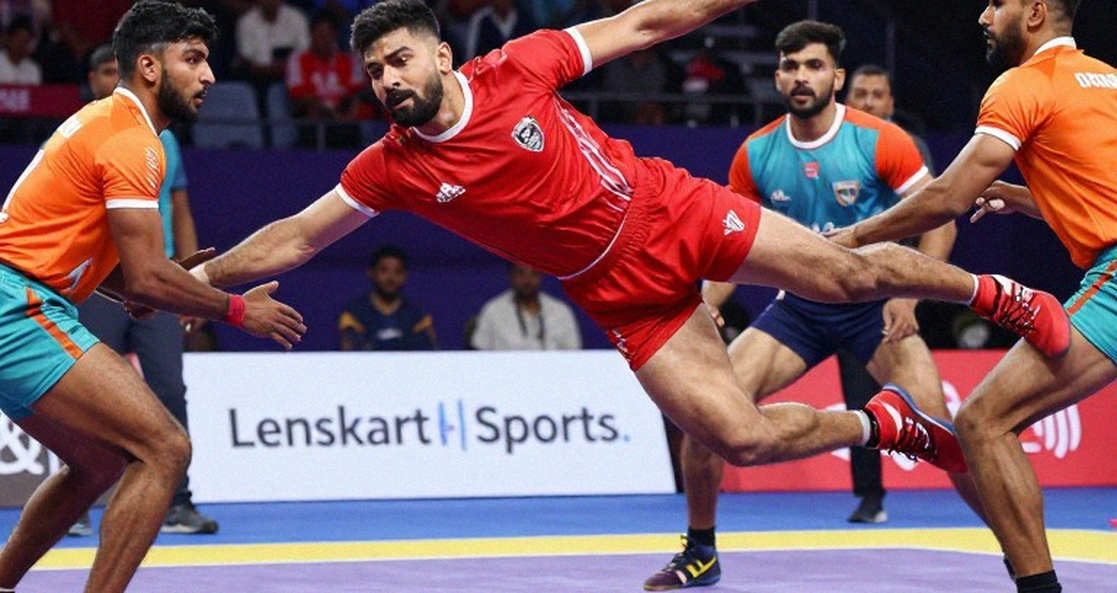
संबंधित खिलाड़ी