
Field Hockey
From Penalty Corners to the Pipeline: Data Versus Narrative in Modern Field Hockey
यह रिपोर्ट आधुनिक फील्ड हॉकी में डेटा-आधारित विश्लेषण की विधि पर केंद्रित है। मुख्य बिंदु: (1) पेनल्टी कॉर्नर गोल का सबसे बड़ा एकल स्रोत है, इसलिए कॉर्नर-संख्या और रूपांतरण दर किसी भी टीम-आकलन की पहली कसौटी हैं; (2) ड्रैग फ्लिक पर अत्यधिक निर्भरता एक ज्ञात कमज़ोरी है, जिसे विपक्षी पहले रनर से बंद करता है; (3) नतीजे और प्रक्रिया (कब्ज़ा, सर्कल-एंट्री, शॉट) का अंतर टिकाऊपन तय करता है; (4) 'हॉकी' शब्द फील्ड हॉकी (एफआईएच) और आइस हॉकी (आईआईएचएफ/एनएचएल) को जोड़ता है — विश्लेषण से पहले कोड स्पष्ट करना ज़रूरी है; (5) ओलंपिक चक्र, एफआईएच प्रो लीग और क्वालिफिकेशन-मार्ग प्रतियोगिता-स्तर का विश्लेषण तय करते हैं; (6) अर्ध-पेशेवर ढाँचा और केंद्रीकृत प्रशिक्षण मॉडल का अंतर प्रदर्शन को सीधे प्रभावित करता है; (7) अंडर-21 प्रदर्शन वरिष्ठ टीम की पाइपलाइन-सेहत का अग्रिम संकेतक है, और ड्रैग फ्लिकर व गोलकीपर के स्थान सबसे कम प्रतिस्थापनीय हैं; (8) हॉकी का व्यावसायिक छत कम है क्योंकि मजबूत पेशेवर लीग का अभाव है और प्रायोजन कुछ ही बाज़ारों में केंद्रित है। निष्कर्ष: हॉकी विश्लेषण तभी ईमानदार है जब वह अपने आँकड़े और आधार स्पष्ट रूप से बताए; आँकड़ों के बिना बयानबाज़ी, और भावना के बिना खेल — दोनों अधूरे हैं।
Field hockey is one of the few sports where the result routinely makes more noise than the process. Four quarters, fifteen minutes each, unlimited rolling substitutions, and a circle where the single largest source of goals is the penalty corner — this structure makes data as indispensable as a team's drag-flicker's wrist. Yet a large part of sports journalism runs in the opposite direction: the conclusion is fixed first, and the numbers and quotations are gathered afterwards.
This report is not the story of one match. It is the story of the method by which modern hockey ought to be understood — and of the places where that method fails silently. Because when an analysis has no measure of circle entries, no penalty-corner data, and no FIH ranking anchor, the greatest danger is not that the analysis will be wrong. The greatest danger is that it will look right.
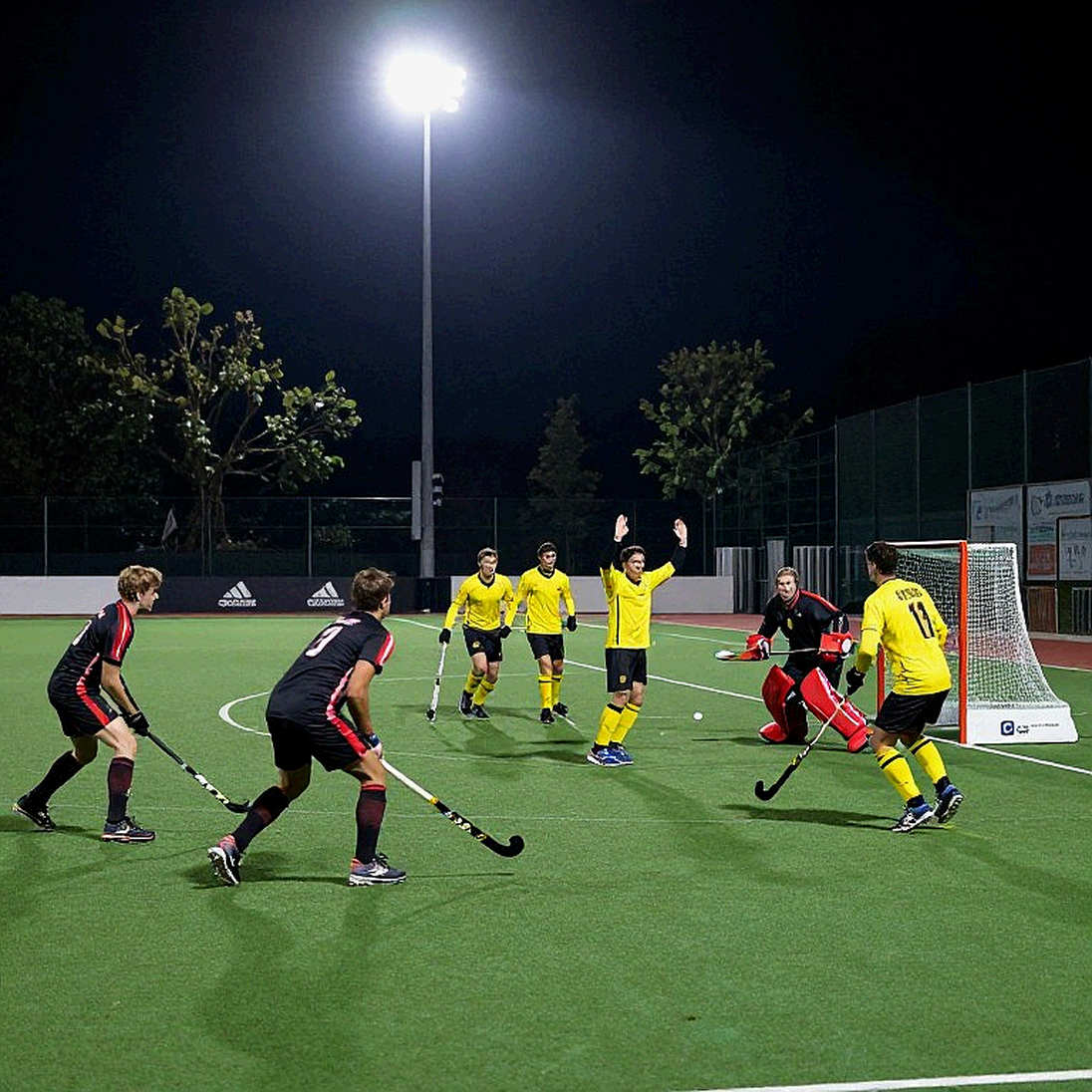
The penalty corner is regarded as one of the single largest sources of goals in modern field hockey. It is awarded for a defensive infringement inside the circle and gives the attacking side a set-piece strike from near the goal line. That means a team's true face can be read from two numbers: how many penalty corners it won, and how many it converted. The first tells you whether the team is building pressure in the circle; the second tells you whether it owns the tool to cash that pressure in. A team with pressure but no tool generally controls the game and still loses. A team with the tool but no pressure can beat any major side on a given evening but cannot win a tournament.
This is why the drag flick is not merely a technique but a strategic asset. The shot — generating power by dragging the stick through the ball with the momentum of the body — is the primary weapon on the penalty corner in today's game. But over-dependence on it is a well-known vulnerability. Against a team whose entire corner game rests on one flicker, the opposing coach does one thing: sends the first runner down that same line and closes the flick's route. At that point the team needs a second option — a variation, a re-circle after the push-in, or a direct strike. Teams without that second option see their corner conversion rate collapse in big matches, and pundits explain it away as 'form'.
The other side of the penalty corner is equally important: defence. The angle of the first runner, how long the goalkeeper holds his ground, and where the defenders keep their sticks — the moment these three fall out of sync, the corner becomes a goal. Modern analysis does not treat corner defence in isolation; it is read as an indicator of a team's overall disciplinary capacity. A team that is sluggish on the corner is usually sluggish in transition too.
Now the point where sports analysis and sports storytelling diverge most sharply — results versus process. Three straight wins do not mean a team is playing well. It may have had less possession in all three, created fewer circle entries, and won because of an exceptional goalkeeping performance or an opponent's missed corners. Such wins are not sustainable at the process level. Conversely, a team can lose three in a row while its possession, circle entries, and shot count were better than the opponent's. Journalism calls the first situation 'momentum' and the second 'crisis'. Analysis reads both inverted.
That is why a report built only on the scoreline is incomplete. An honest hockey report should contain at least four things: how the goals were scored (open play, penalty corner, or penalty stroke), shot and circle-entry counts, corner conversion rate, and recent head-to-head record. Without these, what remains is not analysis but assertion.
One basic confusion deserves mention here. The word 'hockey' by itself joins two entirely different sports — field hockey, governed by FIH rules and featuring four quarters and penalty corners, and ice hockey, governed by IIHF and NHL rules and featuring power plays and line changes. Their terminology, data sets, and strategic logic are not transferable to one another. So the first task of any analysis is to establish which code is the subject. If that is not settled, the rest of the debate is meaningless.
At the level of rules and governance, the biggest live debate in hockey today concerns video referrals and umpiring standards. Referrals are limited in number, and deciding when to use one has become a strategic call for the coaching staff. A referral burned at the wrong moment in a big match can prove costly at the end. Similarly, card and suspension rules directly affect squad depth at tournament level: a one-match suspension for a key defender changes the entire structure. The impact of these rules is not uniform across teams — a side with equal quality on the bench absorbs a suspension; a side without it exits the tournament.
At the level of competition structure, hockey's architecture is clear. The FIH publishes world rankings and runs the Pro League, the annual home-and-away national-team competition — the sport's biggest regular exposure window outside the Olympics. Beyond that sit the World Cup, continental championships, the Nations Cup, and the U21 World Cup. Each tier carries a different analytical weight. A Pro League match and an Olympic qualifier are never the same thing, even when the same two nations are playing.
The Olympic cycle is the axis on which hockey's entire calendar, qualification pathway, and media attention rest. The qualification logic is straightforward: continental champions get direct entry, further berths come through Olympic qualifiers, and ranking-based reallocation fills the rest. But that logic only applies when you know where a team stands — already qualified, in the qualifiers, or eliminated. It is equally necessary to know whether the context is an Olympic year, mid-cycle, or a rebuilding phase. The same defeat is read three different ways in those three contexts.
On the global landscape, men's and women's hockey do not share the same geography of strength, and that difference must be understood before any team assessment. The Netherlands are elite in both; their women's side has been dominant across recent Olympic cycles and their men's side is a perennial medal contender. Belgium's men's programme reached the top over the past decade. Australia's men have traditionally been consistently at the top. Argentina's women have historically been strong. India's men confirmed their revival with bronze at Tokyo 2026 and again at Paris 2026, while their women's programme has not yet reached the same level. That asymmetry is no accident — it is the product of unequal resourcing and unequal pipelines.
The least-reported variable in hockey analysis is professionalisation status. Most national teams are semi-professional: players have limited professional contracts, association stipends, and no durable livelihood structure. That fact directly affects performance, because professional teams can train at high intensity all year and semi-professional teams cannot. This is why the distinction between a centralised training model and a pre-tournament assembly model becomes decisive. In the first, players are together year-round; in the second, they come together a few weeks before a tournament. At identical talent levels, the two models produce entirely different outcomes.
The talent pipeline is the most concrete indicator in this whole debate. Performance at the U21 World Cup is treated as a leading indicator of the health of any senior programme, because it shows the level at which the next generation is being prepared. A country whose U21 side consistently reaches the final rounds usually has an eight-to-ten-year stable base for its senior team. Conversely, where the junior team exits in the first round while the senior team performs miraculously, a vacuum will soon appear — what hockey calls the ebb of a golden generation.
There is a second, often ignored risk of the same kind — the replaceability of specialist positions. Hockey has two positions for which no immediate substitute exists: the drag flicker and the goalkeeper. If a team's primary flicker is injured, its entire corner game can collapse even if the rest of the squad is fully fit. The goalkeeper's slot is sensitive for another reason too: the training cycle for that position is the longest. Teams that maintain dual readiness in these two positions tend to pull ahead in long tournaments.
At the level of team management, three things should be examined: association investment and stability, the quality and tenure of the coaching staff, and the fairness and breadth of selection. Coaching tenure volatility is a chronic problem in hockey — in many countries the coach changes after every major tournament, and the playing style changes with each change. Breadth of selection matters just as much: if selection is confined to a few centres or a few states, a large talent population is left out. The countries that widened their selection base reaped the benefit over the following decade.
At the level of risk profile, five major risks recur in hockey. First, competitive risk — a style against which a team repeatedly gets stuck. Second, talent risk — a drying pipeline. Third, grassroots risk — the shrinking of the game at the base, which erodes squad depth over the long run. Fourth, governance and financial risk — association instability, delayed funding, and political interference. Fifth, rule risk — a sudden rule change that renders a team's existing strength irrelevant. None of these sinks a team alone; they tend to arrive together.
At the industry level, hockey's structural ceiling is clear. Upstream sit youth development, pitches, and equipment; midstream sit national teams, leagues, and events; downstream sit broadcasting, sponsorship, and derivative markets. Hockey's biggest weakness is at the midstream level — the absence or instability of a professional league. Where the league became strong, player earnings rose and so did broadcast value. Where the league remained on paper, the sport's entire economic structure stayed dependent on association grants. Sponsorship is also concentrated in a handful of markets, so hockey's commercial ceiling is low globally. Any industry claim must keep that baseline fact in view.
At the level of public narrative, hockey is rarely neutral. In markets such as India and Pakistan it is tied directly to national sentiment, so a defeat is viewed through a lens bigger than sport and a win is presented as a victory of the entire system. In such an environment, an expectations gap is natural: the distance between market expectation and objective assessment. An honest report's job is to measure that gap, not to fill it. There are four common narrative shapes — the revival of a powerhouse, the continuation of a dynasty, the farewell moment of a golden generation, and the minnow upset. Which label applies requires a ranking and results baseline, not merely emotion.
The essence of this entire discussion is that hockey analysis is honest only when it can state its own basis. If a report does not say how the goals were scored, how many corners were won and converted, who built more pressure in the circle, and what the team's ranking anchor is — then that report is not about the sport, it is about the sport's mood. Both have their place, but they cannot be substituted for one another.
Four signals are worth tracking going forward. First, any team's penalty corner conversion rate and its volatility. Second, the health of its pipeline at U21 level. Third, the nature of its training model — centralised or pre-tournament. Fourth, its ranking trajectory, because a single match result can mislead but twelve months of ranking movement do not lie.
Hockey's beauty is that it does not fully surrender itself to numbers — a split-second decision in the circle, an unexpected rebound, a disciplined first runner. But precisely because of that beauty, it is also incomplete without numbers. Only the journalism that holds room for both endures.

संबंधित खिलाड़ी