
Kabaddi
Kabaddi: From the Village Dirt Court to the Global Stage
कबड्डी क्या है? — दक्षिण एशिया का पारंपरिक संपर्क खेल, जिसमें सात खिलाड़ियों की दो टीमें बिना किसी उपकरण के खेलती हैं; रेडर को 30 सेकंड में विपक्षी पाले में जाकर छूकर लौटना होता है और पूरे समय ‘कबड्डी’ बोलते रहना पड़ता है। कबड्डी कब अंतरराष्ट्रीय पदक खेल बना? — 1982 दिल्ली एशियाई खेलों में प्रदर्शन खेल, 1990 बीजिंग एशियाई खेलों में पहली बार पदक का खेल; महिला कबड्डी 2010 ग्वांगझोउ से शामिल। सबसे बड़ी व्यावसायिक लीग कौन सी है? — प्रो कबड्डी लीग, 2014 में शुरू; इसने खिलाड़ियों की आय, प्रसारण और ग्रामीण पृष्ठभूमि के खिलाड़ियों की दृश्यता को बदला। भारत की स्थिति क्या है? — पुरुष और महिला दोनों में ऐतिहासिक दबदबा, लेकिन 2018 जकार्ता में पुरुष स्वर्ण ईरान ने जीता; 2022 हांगझोउ में भारत ने स्वर्ण वापस जीता। मुख्य चुनौतियाँ क्या हैं? — नियमित अंतरराष्ट्रीय कैलेंडर का अभाव, महिला लीग ढांचे का छोटा आकार, ग्रासरूट सुविधाओं और खिलाड़ी सुरक्षा/बीमा में कमी, तथा संघ-लीग-महासंघ के बीच तालमेल। क्या कबड्डी ओलंपिक खेल है? — नहीं, यह अभी ओलंपिक कार्यक्रम का हिस्सा नहीं है; इसका मुख्य अंतरराष्ट्रीय मंच एशियाई खेल हैं।
In a village somewhere in India, at night, an open field, barefoot players, and a voice echoing over and over: “kabaddi, kabaddi, kabaddi.” That scene is centuries old. The same game is now played indoors under LED lights, with high-speed cameras and television commentary, watched by millions in a single evening. Both are the same sport, but the distance between them is more interesting than that of almost any other Indian game. Kabaddi’s identity lies in this duality: it is as traditional as it is modern, as local as it is global. And that duality is both its greatest strength and its greatest vulnerability.
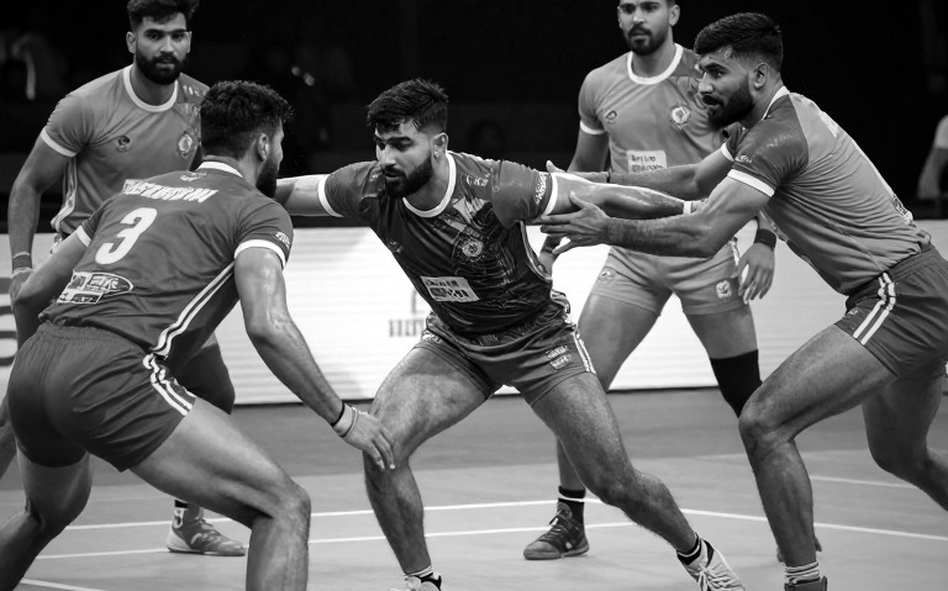
The structure of the sport is as simple as any popular game can be. Two teams of seven, one court, and no equipment at all. The raider crosses into the opponent’s half within thirty seconds, touches defenders, and returns to his own side. Throughout, he must keep chanting “kabaddi” to prove he is still breathing. If he is caught on the way back, he is out; if he touches even one defender and returns safely, the point is his. Sending the entire opposing team out earns bonus points, called a “lona.” This simplicity is kabaddi’s greatest strength: it can be played anywhere, at any time.
But that same simplicity creates a problem for television. A spectator standing at the court understands instantly who was touched and when a foot crossed the line. For a viewer watching through a camera, the same moment becomes a mystery. Kabaddi’s televised version therefore does not change the game so much as change the way the game is told: slow motion, an overhead camera, instant statistics, and commentary that turns every small movement into narrative. A sport once made of noise and grunts now has an entire vocabulary.
Kabaddi grew out of the soil of South Asia, and its many local names survive today. In India it is called ‘sanjeevani’ in some regions and ‘hu-tu-tu’ in others; in Bangladesh it is ‘hadudu,’ in Sri Lanka ‘guddu,’ and in Nepal ‘dudhi.’ That variety of names alone shows the sport belongs not to one place but to the whole region. In its modern competitive form it appeared as a demonstration sport at the 2026 Delhi Asian Games and became a medal sport for the first time at the 2026 Beijing Asian Games. It has been part of every Asian Games programme since.
From the 1990s onward, India’s dominance in men’s kabaddi was close to undisputed. India was ahead on three fronts: coaching structures, player experience, and a cultural understanding of the game. Winning gold at the Asian Games had become an expectation for the Indian team, and that expectation eventually became the heaviest pressure of all.
The pressure broke at the 2026 Jakarta Asian Games, when Iran won the men’s kabaddi gold and ended India’s long monopoly. Iran’s breakthrough was no accident. The country invested in kabaddi as a medal-winning sport: training centres were built, coaches were developed, and players were given stable opportunities. Four years later, at the 2026 Hangzhou Asian Games, India took the gold back, but by then it was clear that kabaddi no longer belonged to a single pole. The rise of teams like Iran and South Korea made the competition real, and competition is the true test of a sport’s international relevance.
The launch of the Pro Kabaddi League in 2026 changed the economics of the game. A private organiser and a major broadcast network worked together to turn kabaddi into primetime television: player auctions, distinct team identities, mat courts, lights and music at the opening, and a production team built to turn every match into a spectacle. Within a few seasons, player incomes moved from government jobs and local tournament prize money to genuine professional contracts.
The league’s biggest impact has been social rather than financial. A large share of players come from rural areas of Haryana, Uttar Pradesh, Tamil Nadu and Rajasthan, families for whom the sport became a route to stable income for the first time. Compared with cricket, the barriers to entry in kabaddi are far lower: grounds are cheap, no equipment is needed, and talent is identified early. That is why kabaddi has become a rare and effective channel of social mobility in rural India.
The modern face of the sport can be read through three names. Pardeep Narwal, whose ‘dubki’ and low, bending raids through chains of defenders established raiding as an art form, and who was for years the league’s leading scorer. Anup Kumar, who captained India and whose calm tactics showed that in kabaddi the mind matters more than the legs. And Fazel Atrachali, the Iranian defender who became the league’s most reliable corner, proving that the competition is no longer an exclusively Indian stage. Together they represent three directions of the sport: spectacle, strategy and internationalisation.
Women’s kabaddi entered the Asian Games as a medal sport in Guangzhou 2026, and the Indian women’s team built its own dominance from there. Off the court, however, that dominance did not grow nearly as fast. The league structure for women has remained far smaller than the men’s game, with less broadcast exposure, less sponsorship and lower contract values. The gap is not only statistical; it is the product of investment decisions. Where money goes to the proven market of men’s broadcast, the women’s game is left to prove a market on its own.
Beyond India and South Asia, kabaddi’s presence has grown. Iran is now a top-tier team, and federations and competitions exist in countries such as South Korea, Japan, Kenya, Britain, Poland and Argentina. The 2026 Kabaddi World Cup, which India won, showed the ambition behind that expansion. But the global calendar remains thin: in the long gaps between Asian Games, major international tournaments are scarce, and without regular competition it becomes hard for a new generation to stay in the sport.
At the administrative level, kabaddi’s central problem is coordination among three centres of power: national federations, the international federation and the private league. When the league’s commercial interest and the national team’s performance interest collide, the player is caught in between: national camps squeezed into a crowded league calendar, injury risk, and contractual insecurity. Many players still lack permanent insurance or any post-retirement protection.
Commercially, the league model rests on broadcast rights and sponsorship rather than ticketing and stadium attendance. That model works as long as viewership holds. Expanding the number of teams thins out the talent pool and puts pressure on the quality of every match, a balance that is difficult for any league and especially for kabaddi, where the base of elite players is still limited.
The real test lies off the court. The gap between a village dirt ground and a city mat court remains wide. School sport, coaching, medical support, a safe training structure for women and anti-doping enforcement are all funded far behind the league’s glamour. Until that gap is closed, kabaddi’s success will remain confined to a few cities and a few stars.
Kabaddi has proved that a rural, equipment-free game can become a modern television product. The next question is not how many new stars it will produce, but whether the league’s success can be converted into solid foundations: a regular international calendar, a stronger women’s structure, better grassroots facilities and player protection. The sport that emerged from the dirt court now stands inside a closed room, and opening that door depends entirely on it.
संबंधित खिलाड़ी